Case study
B2B SaaS
Agentic Ai X Salesforce
Period
3 months
Team
Ravikant Joshi
Pratik Dev
Riya Ghosh
Role
Product Designer
Skills
Brand Identity
Ai Flow Architecture
Product Strategy
Tools
Figma
Photoshop
Figma Make, Claude
Context
The average sales rep is buried in administrative work—updating CRMs, logging calls, finding data—which shatters their focus and kills sales momentum. The problem isn't just the loss of time; it's the loss of flow.
We didn't set out to build another productivity tool. We set out to design Rosa, an AI partner designed not just to manage data, but to anticipate the next best move, highlight the right opportunities, and clear the path for what sales reps do best: build connections and close deals
What if a sales rep could spend their entire day selling?
Solution
An AI agent that provides predictive guidance and automates the entire sales workflow, turning data into conversations.
I led the design of Rosa, a SaaS platform that acts as a strategic partner for sales representatives. Rosa integrates with a rep's core tools to deliver a prioritized daily brief, automate research, and assist in crafting personalized outreach. From surfacing the top 1% of leads to providing a "Deal Memory" for every interaction, Rosa is designed to be the engine for sales success.
The Problem
Sales reps are drowning in tasks, but starving for momentum.
My research into the sales workflow revealed a universal frustration. Reps like our persona, "Jordan," start their day facing a noisy pool of 500+ leads and a mountain of administrative tasks. This creates a reactive, inefficient, and demoralizing work environment.
Pain Points
Decision Fatigue
With hundreds of leads, reps don't know where to focus first. They waste the first, most productive hour of their day manually filtering lists instead of engaging high-intent prospects.
The "Research Tax"
Preparing for a single outreach call requires toggling across LinkedIn, Google News, industry blogs, and CRM history. This 1-hour, multi-tab research process for every key lead is a massive drain on productivity.
The Connection Gap
A fragmented workflow across multiple apps makes it impossible to have a single, unified view of a client. Key details from past interactions get lost, and outreach feels generic, not personal.
Key Insight
The solution wasn't a better dashboard. It was an intelligent agent that could perform the research and prioritization work for the rep, allowing them to start their day with action, not administration.
The Design Process
An AI-Augmented Workflow: From Concept to Prototype in Days, Not Weeks. To design a product centered on speed and intelligence, our process had to embody those same principles. Traditional design sprints felt too slow. Instead, I adopted a modern, AI-augmented workflow that leveraged generative AI as a foundational partner to accelerate the journey from a blank canvas to a testable prototype.
1. AI as the Starting Block
Instead of spending weeks on manual user flow diagrams and wireframes, I began by prompting AI with the core persona and problem. I used generative AI to: Brainstorm initial user flows for "a day in the life of a sales rep named Jordan." Generate multiple layout concepts for a proactive, AI-driven dashboard. Explore different information architectures for presenting complex data like lead scores and intent signals. This AI-first approach provided an incredible "base start," allowing us to bypass the most time-consuming parts of the initial ideation phase. It turned the "blank canvas problem" into a multiple-choice question, providing a rich set of concepts to refine.
2. Rapid Prototyping in Figma
Instead of spending weeks on manual user flow diagrams and wireframes, I began by prompting AI with the core persona and problem. I used generative AI to: Brainstorm initial user flows for "a day in the life of a sales rep named Jordan." Generate multiple layout concepts for a proactive, AI-driven dashboard. Explore different information architectures for presenting complex data like lead scores and intent signals. This AI-first approach provided an incredible "base start," allowing us to bypass the most time-consuming parts of the initial ideation phase. It turned the "blank canvas problem" into a multiple-choice question, providing a rich set of concepts to refine.
3. Designing the Core Agent: "Ask Rosa"
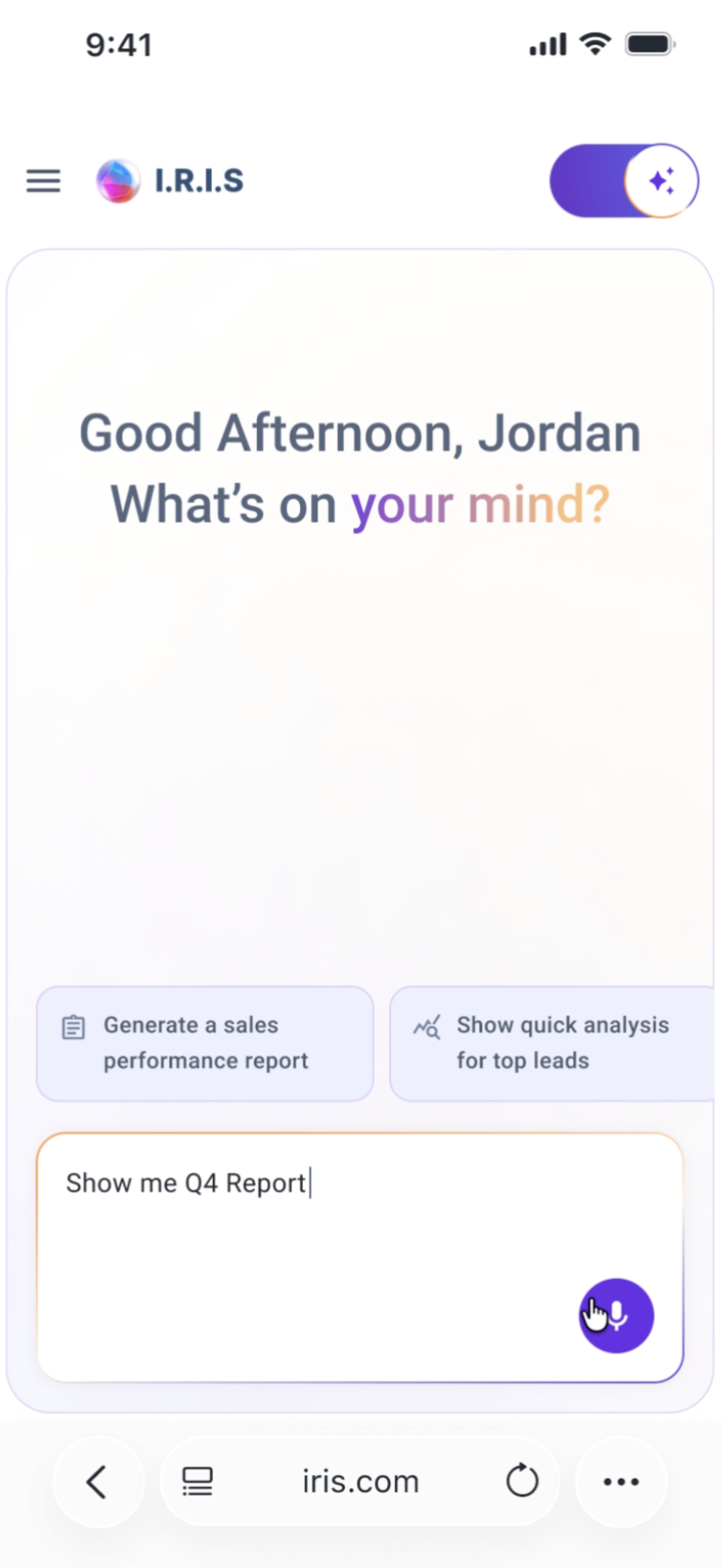
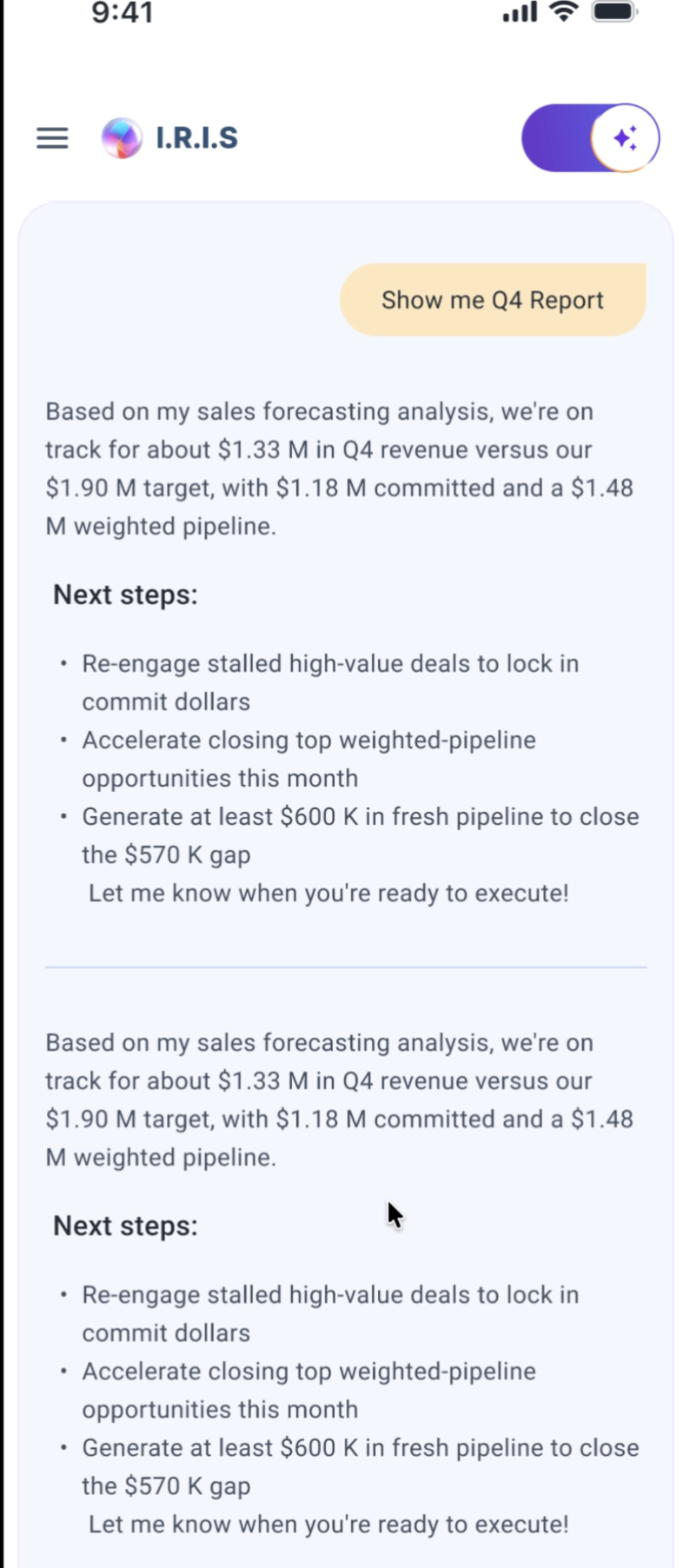
The centerpiece of the platform is "Ask Rosa," the central, conversational AI agent. This isn't a simple chatbot; it's designed to understand intent and execute multi-step tasks across integrated systems (CRM, email, calendar). The design process focused on mapping these agentic commands: Task Decomposition: we started by breaking down complex user requests into their fundamental actions. For example, the command "Get me prepped for my call with Delta Tech" was decomposed into a sequence: Query CRM for contact history → Scan Deal Memory for recent activity → Find related call recordings → Generate Smart Script with key talking points.
4. Designing the "Sub-Agentic" Assistance
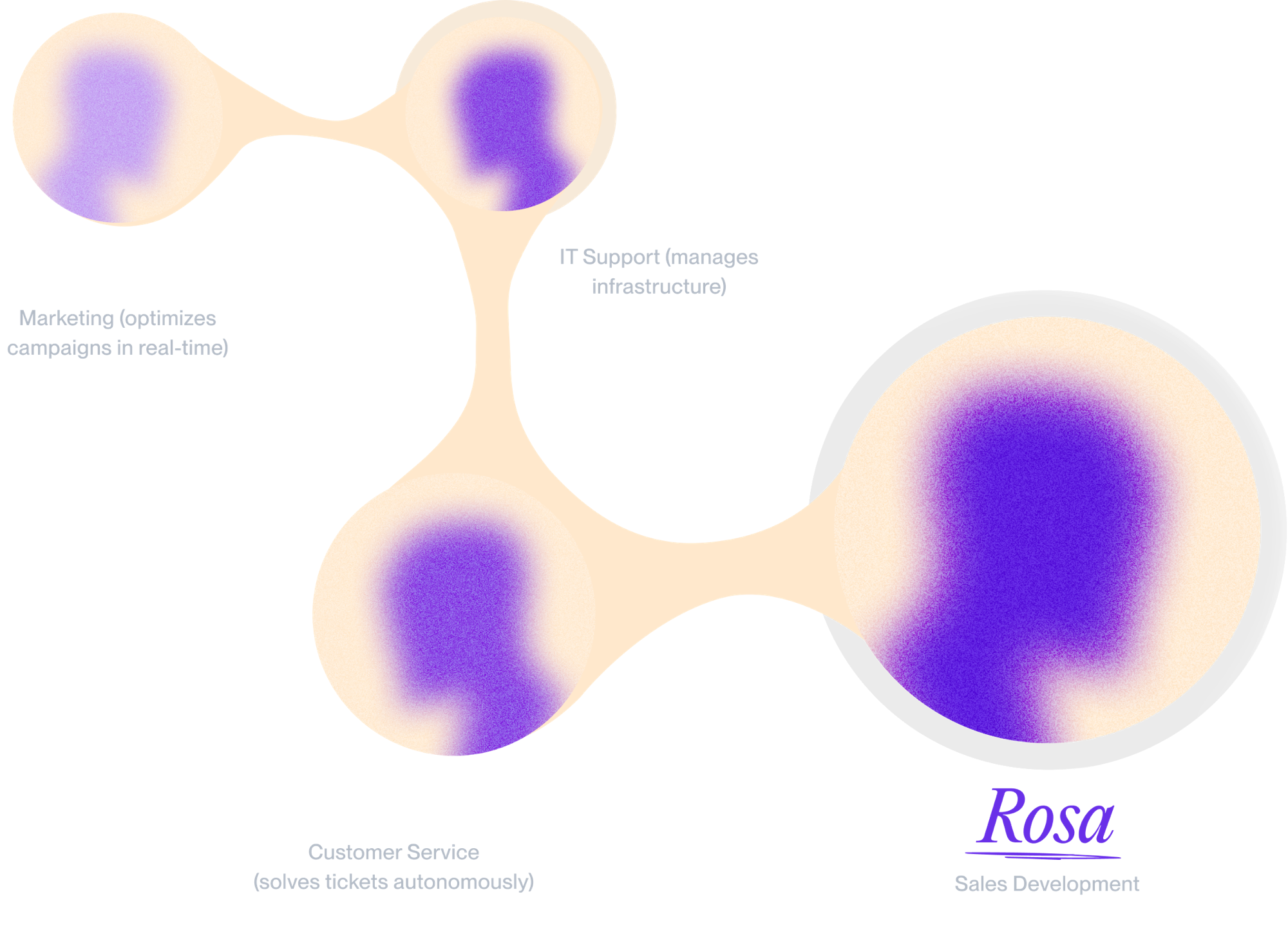
While "Ask Rosa" is the powerful command center, we also designed smaller, "sub-agentic" helpers that are embedded directly into the UI. These are proactive, contextual AI features that work silently in the background to automate specific tasks without needing an explicit command. The design involved identifying high-friction points in the workflow and embedding an AI solution: The "Lead Score" Agent constantly analyzes incoming leads, automatically scores them based on predefined criteria, and surfaces the justification for the score. The "Momentum" Agent monitors deal engagement. When it detects a key event (like a proposal being opened multiple times), it triggers the "Nudge" notification. The "CRM Hygiene" Agent scans for deals that haven't been updated and changes the priority status matrix to low priority.
The Solution
A strategic partner that guides the entire sales motion. The Rosa platform is designed to be a rep's single source of truth and their primary strategic partner, turning hours of manual work into minutes of high-impact selling.
1. The Strategic Start
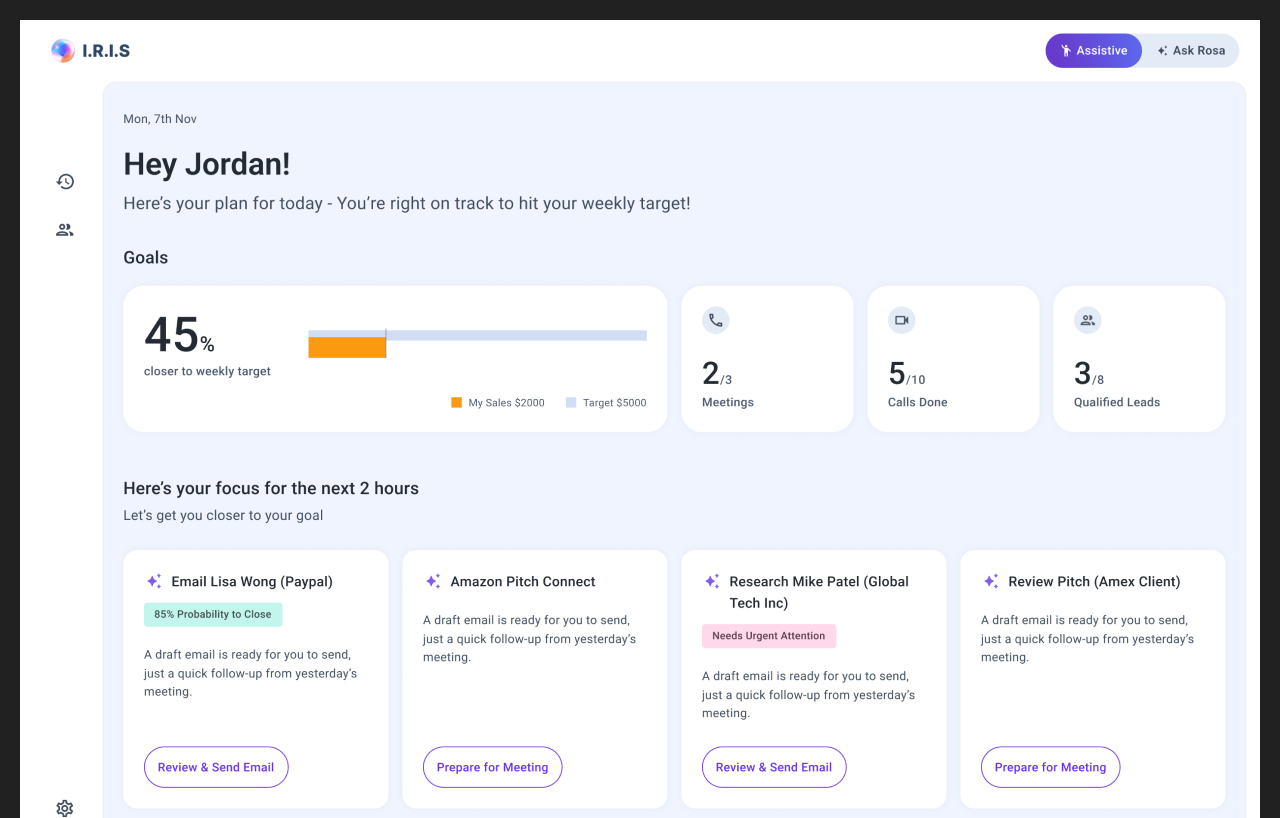
A strategic partner that guides the entire sales motion. The Rosa platform is designed to be a rep's single source of truth and their primary strategic partner, turning hours of manual work into minutes of high-impact selling. Jordan begins his day with Rosa's brief, instantly knowing which 7 of his 500 leads are showing the strongest intent signals, and which 3 stalled deals need immediate attention.
2. The Intelligent Outreach
Jordan clicks on a high-score lead. Rosa provides the full research briefing and suggests a personalized email draft based on the lead's recent activity. Jordan tweaks it and sends. The entire flow, from qualification to outreach, takes under 10 minutes.
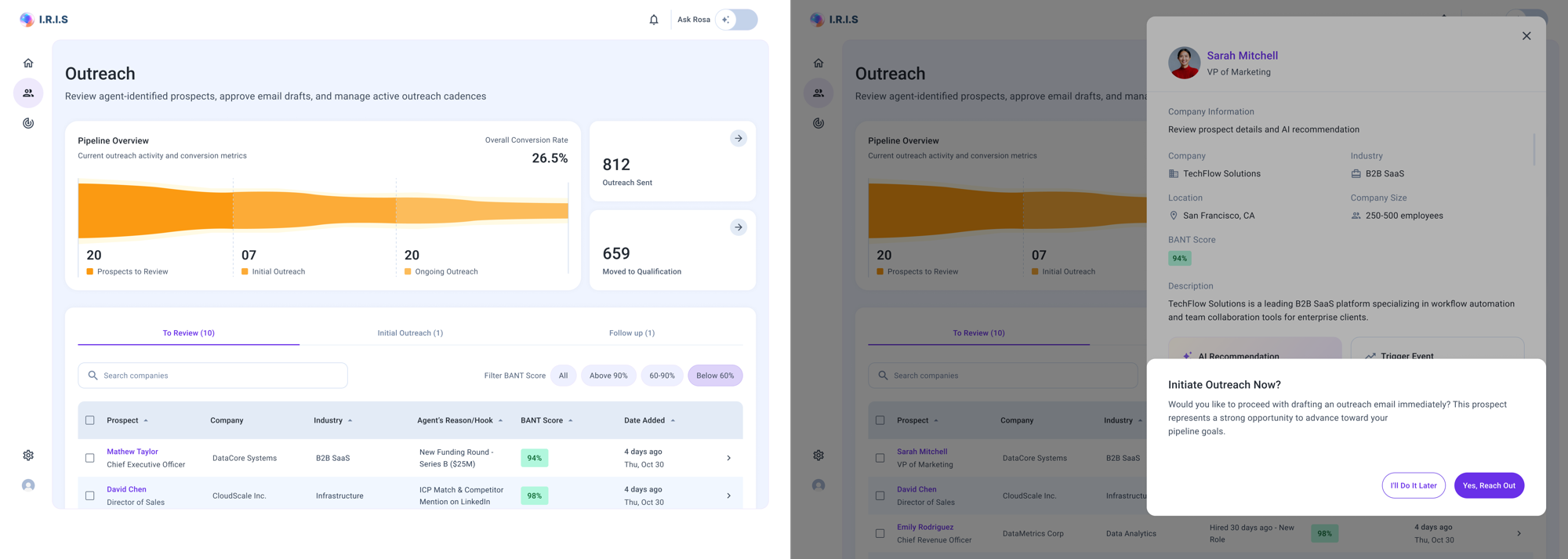
3. The Momentum Nudge
Later, Rosa detects the lead has opened the proposal twice and sends a notification: "Proposal opened by Delta's VP twice in the past hour. Loop in AE before the window closes?" A deal acceleration moment is created.
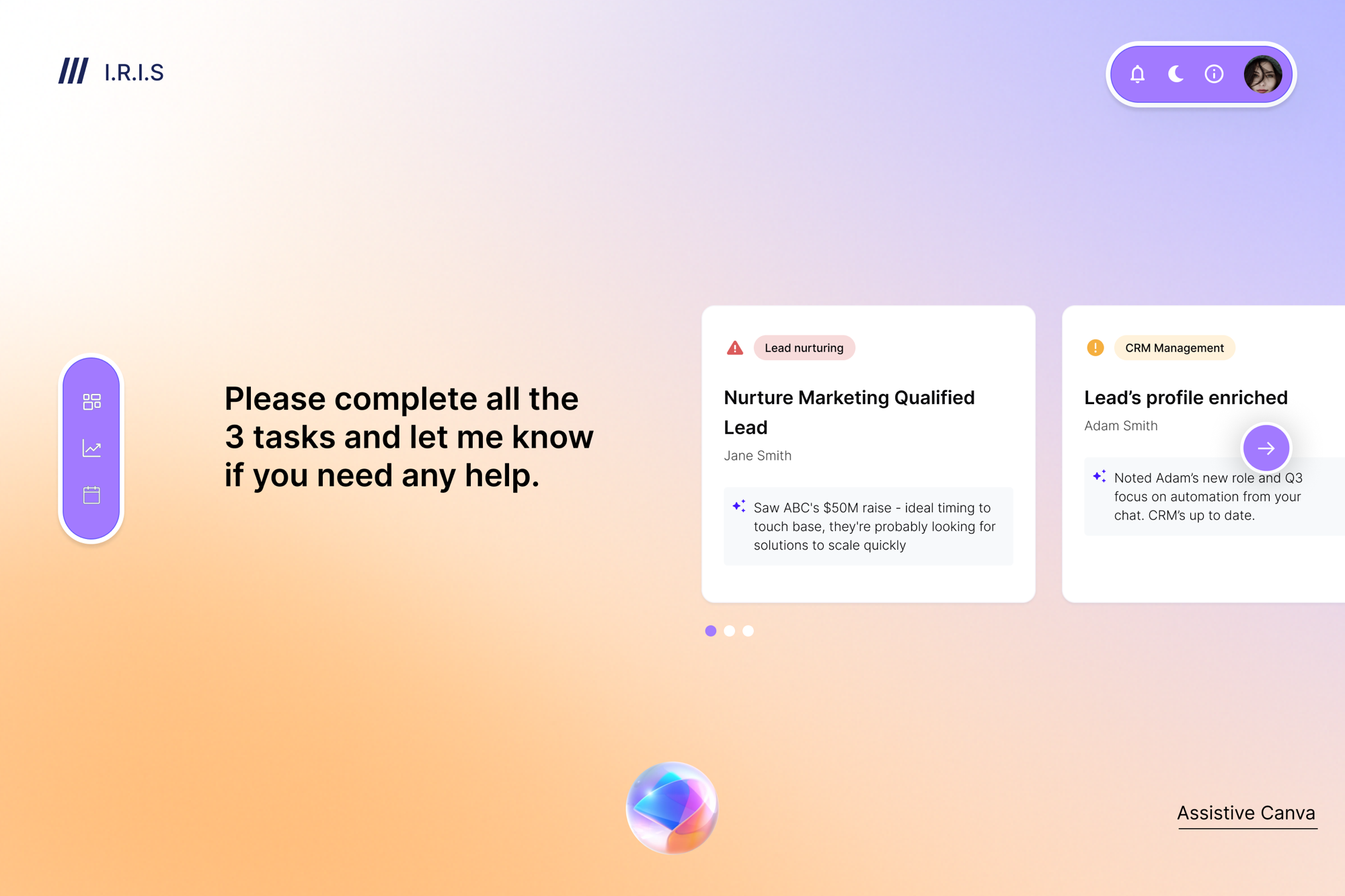
4. Assistive Canvas
Designing a modular, customizable dashboard that would serve as the rep's "mission control." We wanted to keep layout simple needs: Prioritized Tasks, At-Risk Deals, Key Metrics, and an AI Activity Feed. The key innovation was making these blocks both AI-curated and user-configurable, allowing reps to arrange their workspace to match their personal workflow.

The Outcome
By automating admin work and providing predictive guidance, Rosa fundamentally changes the nature of the sales role.
Reflection
This project taught me that the future of enterprise AI isn't just automation, but anticipation. Designing Rosa required a shift from creating interfaces that display data to designing systems that provide predictive, actionable guidance. It's about empowering the user to make the best next move, every time.
The biggest design challenge was building trust in the AI's autonomy. A sales rep's relationships are their most valuable asset; they need to trust that the AI is enhancing, not risking, those relationships. We solved this by designing for a "glass box" AI: for every recommendation, Rosa shows the "why" behind it. For all external communication, we kept a "human-in-the-loop" model, where the rep gives the final approval.
If I were to continue this project, I would focus on the "AI Coaching" aspect. I'd explore using sentiment analysis on call recordings to provide reps with personalised feedback on their conversations, helping them improve their technique over time. This would evolve Rosa from a strategic partner into a true career coach, fully realising the vision of a system built for Momentum, Connection, and Success.